
Maho vs Arc: where the agentic browser goes after Arc
Arc was the most ambitious consumer browser of the early 2020s. In late 2024, The Browser Company stopped active work on Arc to build a different product called Dia. Arc still runs, and a lot of people still use it, but the roadmap is closed.
This is not a victory lap. Arc influenced almost everything Maho ships. Picking up where Arc stopped means being honest about what Arc reached for, what it never finished, and where Maho takes the idea somewhere different.
The Arc context, fairly stated
Section titled “The Arc context, fairly stated”Arc launched as a public beta in 2022. It was the first consumer browser in two decades to question the basic chrome of a browser window. The address bar moved. The tab strip moved. The sidebar became the default surface. New behaviors like Spaces, Little Arc, and the command bar were not extensions or settings, they were shipped as the spine of the product.
Arc was made by The Browser Company of New York, a venture-funded startup founded in 2019. They did the work of every consumer-facing browser team. They moved fast. The product ran on Chromium, polished hard, and had a clear point of view. People liked it.
In late 2024, The Browser Company posted a long letter saying Arc was complete enough, that they were not going to ship many more features into it, and that the next product was a different browser called Dia, focused on AI. Existing Arc users still get security updates. New product work goes into Dia.
That is the context. Arc users did not lose their browser overnight. They lost the future of their browser, which is a different kind of loss. The product still works, but the curve of new ideas inside it has flattened. People who liked the direction Arc was pointing have to look at what comes next.
What Arc got right
Section titled “What Arc got right”Arc was right about three things, and the rest of the industry has been borrowing them ever since.
The first is that the sidebar is the right home for tabs. The horizontal tab strip, which has not changed since 2008, runs out of space at fifteen tabs and gives up. A vertical sidebar works at fifty. Arc built the sidebar as the default and treated the horizontal tab strip as a choice, not a constant.
The second is the command bar. Arc made cmd plus T do something more than open a tab. It turned the address bar into a place to navigate, search, switch tabs, jump to spaces, and run commands. The address bar became a launcher. This is a small change in surface and a large change in mental model.
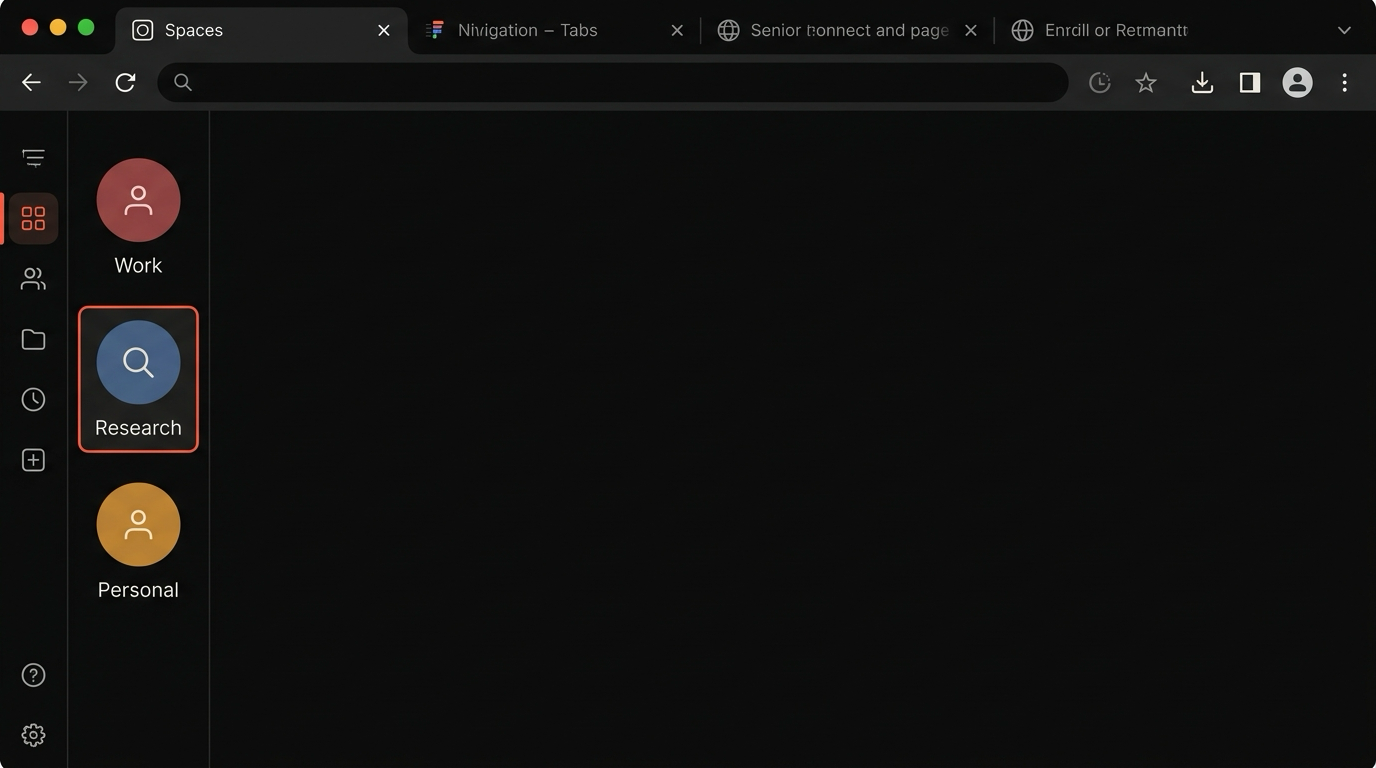
The third is Spaces. A Space is a named container of tabs, bookmarks, theme, and extensions. It is heavier than a tab group and lighter than a profile. It maps onto the way knowledge workers actually divide their time: work, personal, side project, research. Spaces is the feature most Arc users miss when they go back to other browsers.
Arc also got the polish right. Animation timings, font choices, the small interactions in the command bar. Polish does not show up on a feature checklist. It is the reason people stayed.
What Arc never finished
Section titled “What Arc never finished”Arc reached for two things that never landed.
The first is agentic action. Arc had Boosts and a chat-style assistant, but the assistant could not call tools, could not act on the page, and could not coordinate across tabs. It read content and answered questions. By 2024 standards that was fine. By 2026 standards a chat panel that cannot do anything is the floor, not the ceiling.
The second is a programmable surface. Arc was opinionated about what the browser should look like. It was closed about how to extend it beyond Boosts. There was no MCP-style tool protocol, no way to let an external server expose a verb to the browser, no way for a power user to plug their own pipeline into the browser the way they plug it into a terminal.
Arc was a strong product. It was not a platform. The Browser Company decided the next leap was a fresh codebase, not an Arc rebuild. That is a rational call. It also leaves the territory of the agentic, Spaces-first browser open.
How Maho approaches the same problems
Section titled “How Maho approaches the same problems”Maho is a new macOS browser, built on Chromium, designed around the agentic side panel from day one. The shape of the product overlaps with Arc on purpose. The execution does not.
| Axis | Arc | Maho | | --- | --- | --- | | Tab surface | Vertical sidebar, default | Vertical sidebar, default | | Workspaces | Spaces with theme and tabs | Spaces with tabs and per-Space settings | | Command bar | cmd plus T launcher | cmd plus K launcher with action verbs | | AI panel | Chat over current page | Agentic side panel with tool calls | | Tool calling | None | Built-in tools plus user MCP servers | | Page context | Read-only | Read plus per-tool action with permission | | BYOK | None | OpenAI-compatible, Anthropic, Ollama, LM Studio, custom | | Telemetry | Opt-out | Off by default | | Account required | Yes, for sync | No, sync uses paired devices | | Engine | Chromium | Chromium | | Status | Maintenance only | Pre-release, active development |
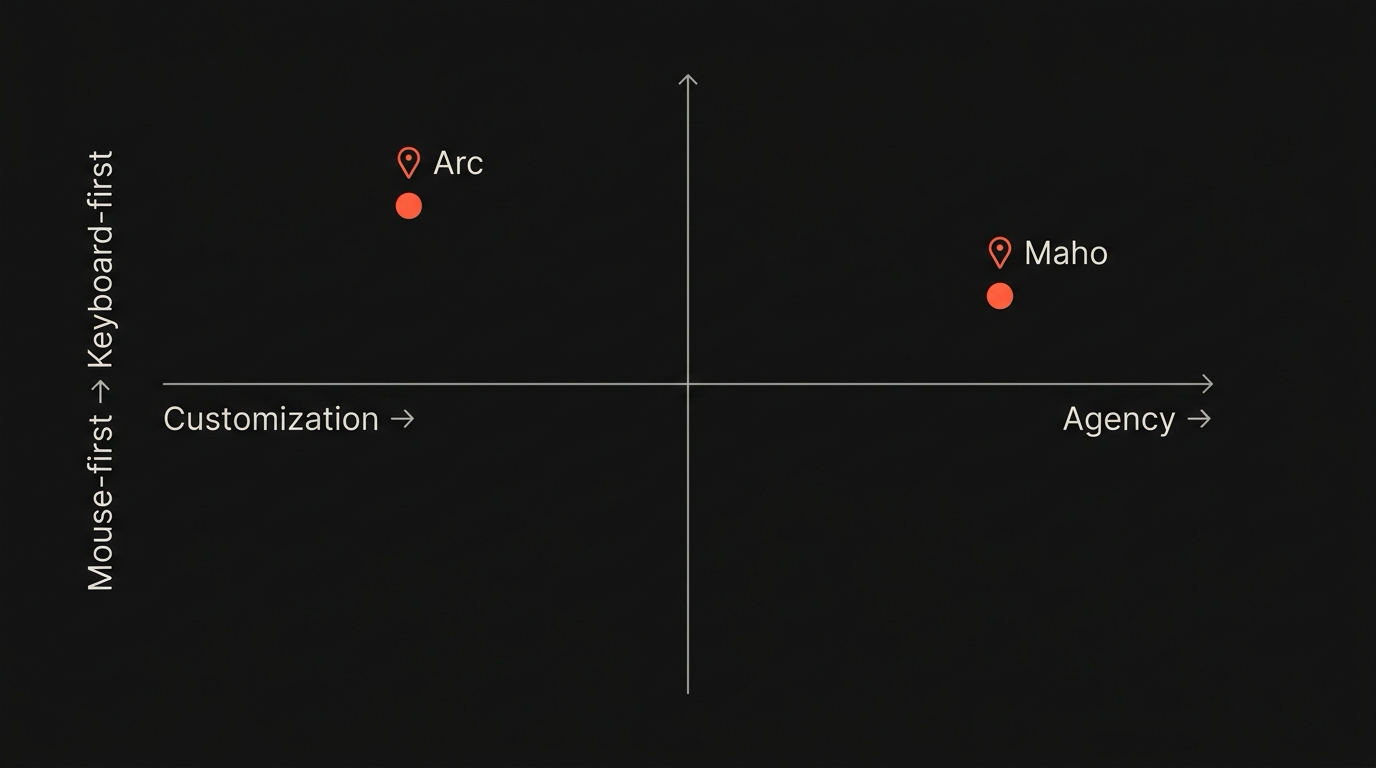
The two products share a worldview about tabs and Spaces. They diverge on what happens after you ask the browser a question. Arc answers. Maho answers and, when you grant it, acts.
The Maho Spaces documentation covers the implementation in detail. The short version is that a Space owns its tabs, its pinned items, and its AI panel state. Switch Space and the panel switches with you. The page context the AI sees is the Space you are in, not a global blob.
Where Maho is not Arc
Section titled “Where Maho is not Arc”Maho is not trying to be Arc with tools attached. There are three places we made a different call.
We do not require an account. Arc shipped sync as a feature that needed a Browser Company login. Maho ships sync as a paired-device protocol that runs through a relay we cannot read. There is no Maho account because there is no central thing to attach an account to.
We do not optimize for design ambition. Arc cared about the look of the browser as a product surface. Some of that work was great. Some of it cost the team feature velocity. Maho cares about a clean, dense, keyboard-friendly UI, and stops there. We are not shipping a tab that splits in two when you nudge it.
We do not bundle a model. Arc planned to ship deeper AI before the pivot. Maho ships BYOK from day one. The browser is the host. The model is yours to pick. This is a different bet about where the AI value will land in the next two years.
Notes for Arc users
Section titled “Notes for Arc users”If you are coming from Arc, three things will feel familiar and one will feel different.
Familiar: the sidebar with vertical tabs, the Spaces concept, and the command palette. The default keyboard model is close enough that muscle memory transfers in a day.
Different: the side panel. In Arc, the AI panel is a chat box. In Maho, the side panel is a control surface. It can call tools, see the page with permission, and act on results. There is a learning curve because the surface is more powerful than chat.
Importing your Arc data uses the standard Chromium import path: history, bookmarks, passwords. Spaces themselves do not have a public export format from Arc, so you will rebuild Spaces by hand the first time. Most Arc users have under ten Spaces, so this takes one sitting.
If you want a longer side-by-side against more browsers, the comparison hub covers Maho against the rest of the 2026 lineup, including Dia, Chrome with Gemini, and Brave with Leo.
Join the waitlist
Section titled “Join the waitlist”Maho is in pre-release for macOS. If you used Arc and miss the part where the browser had a point of view, you are the audience. Join the waitlist.