BYOK vs managed AI: what you give up, what you keep
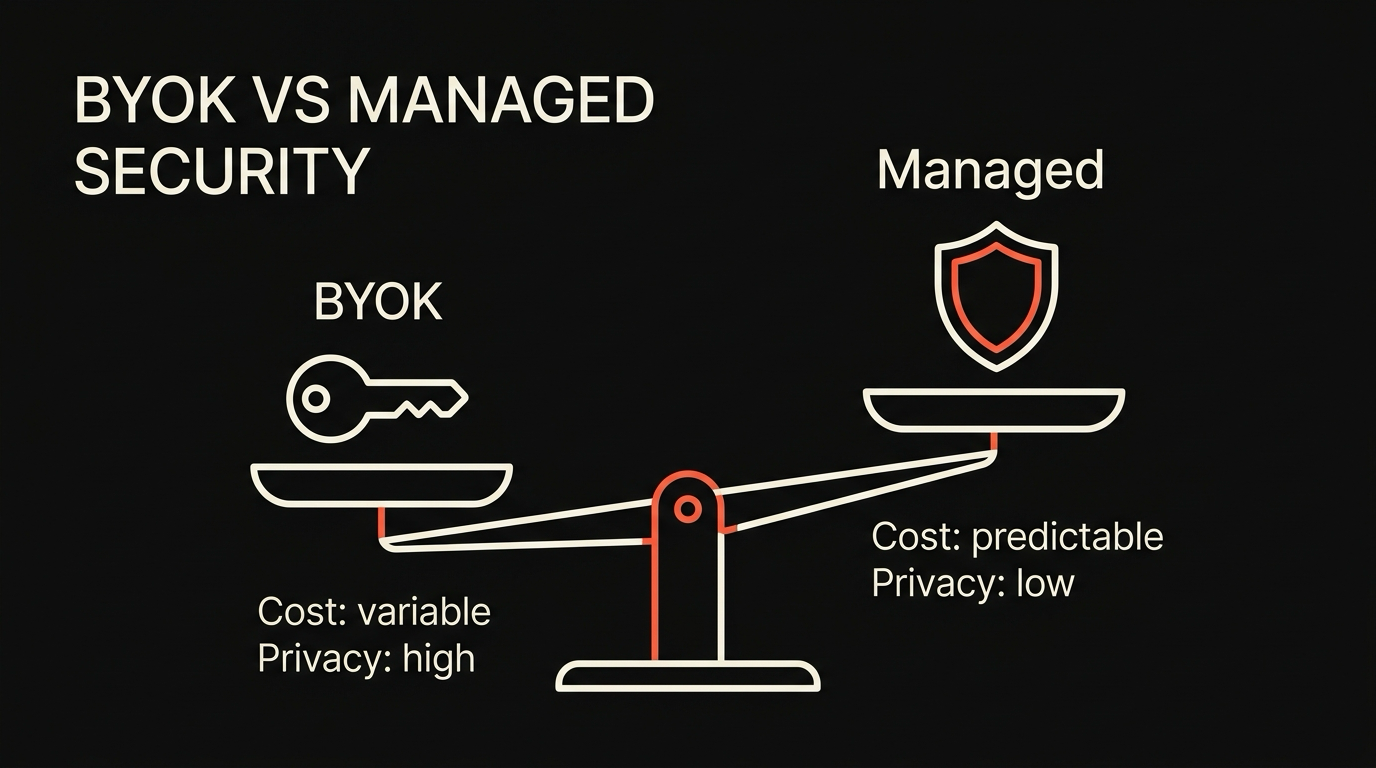
The pitch for managed AI is convenience. The pitch for BYOK is control. Both pitches are true. Both pitches skip the parts that matter.
This post compares the two pricing shapes the way we look at them inside Maho. Where the costs really sit, what each model takes from you, and which one most users actually land on after a month of real use.
The two pricing shapes
Section titled “The two pricing shapes”Managed AI bundles model access into the product. You pay one subscription, the vendor pays the inference bill, and you stop thinking about tokens. The browser ships with a key the vendor controls, routed to a model the vendor picked.
BYOK flips that. You bring your own key from OpenAI, Anthropic, Google, or a self-hosted runtime. The browser is the client. The model bill is yours, billed directly by the provider you chose. The vendor of the browser sells you the browser, not the inference.
There is a third shape worth naming: fully local. A model runs on your laptop, no key required, no network call. We treat local as a sub-case of BYOK because the operational shape is similar. You own the runtime.
The shapes look symmetric on a feature page. They are not symmetric in practice. The asymmetry is the point of this post.
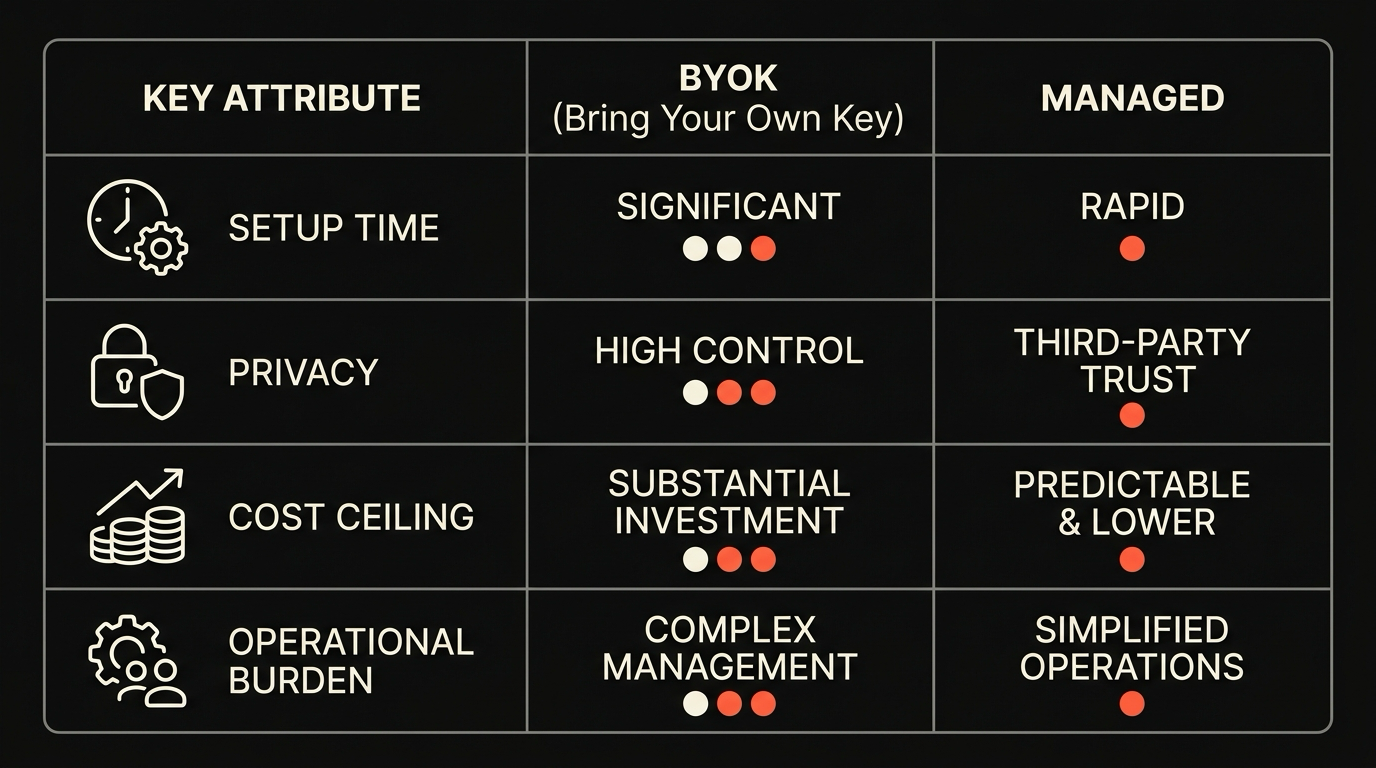
What you give up with managed
Section titled “What you give up with managed”The first thing you give up is routing transparency. You do not know which model answered. Most managed products switch models silently to control cost, especially on cheaper plans. Today’s “fast model” is GPT-4o-mini, next quarter it is something else, and your prompts behave differently for reasons you cannot trace.
The second thing you give up is data posture. The vendor terms govern what happens to your prompts and the page text the assistant reads. Some vendors retain prompts for thirty days for abuse review. Some train on opted-in conversations. Some do neither. The terms change. You are signing up for the policy, not the model.
The third thing you give up is latency control. Managed AI runs in the vendor’s region with the vendor’s queue. When that queue is hot, your assistant gets slow, and there is nothing you can do. We have measured side panel response times degrade by two to four seconds during US business hours on every major managed provider.
The fourth thing you give up is provider choice. If the vendor picked Anthropic, you get Anthropic. If you preferred a smaller model with better tool calling, that preference does not exist in the product surface.
What you keep is real. One bill. No setup. No “is my key valid” error to debug at 11pm. For a lot of users, that tradeoff is fine.
What you give up with BYOK
Section titled “What you give up with BYOK”BYOK is not free of costs either. The honest list is shorter, but it is real.
The first thing you give up is zero-config startup. You have to go to the provider’s dashboard, generate a key, paste it into the browser, and pick a model. We have made this take ninety seconds. It still takes ninety seconds.
The second thing you give up is a single bill. If you mix providers, you have a bill from each one. For most users this is one bill from one provider, so the difference is small, but it is non-zero.
The third thing you give up is a unified abuse story. When something goes wrong with a managed product, the vendor handles it. With BYOK, the vendor of the browser is not the vendor of the model. If the model returns garbage, that is between you and the model provider. We can help you debug the request, not the response quality.
The fourth thing you give up is bundled model upgrades. Managed products quietly swap to a better model when one ships. With BYOK, you decide when to switch from gpt-4o to gpt-4.1. That is more control and slightly more attention.
What you keep is also real. You see the model name. You see the prompt. You see the response. You can switch providers in one minute. You can run fully local for a class of tasks. Your data path is yours.
Cost comparison at three usage tiers
Section titled “Cost comparison at three usage tiers”Token math is where the marketing pages get hand-wavy, so here are the numbers we use. Public list prices as of the time of writing, rounded for clarity, mixed input and output tokens at a 3:1 ratio.
| Tier | Tokens per month | GPT-4o managed | Claude Sonnet managed | Llama 3.1 8B local |
|---|---|---|---|---|
| Hobby | 10M | ~$45 | ~$60 | ~$0 (your power bill) |
| Pro | 100M | ~$450 | ~$600 | ~$0 (your power bill) |
| Team | 1B | ~$4,500 | ~$6,000 | not viable on a laptop |
A few things stand out from the table.
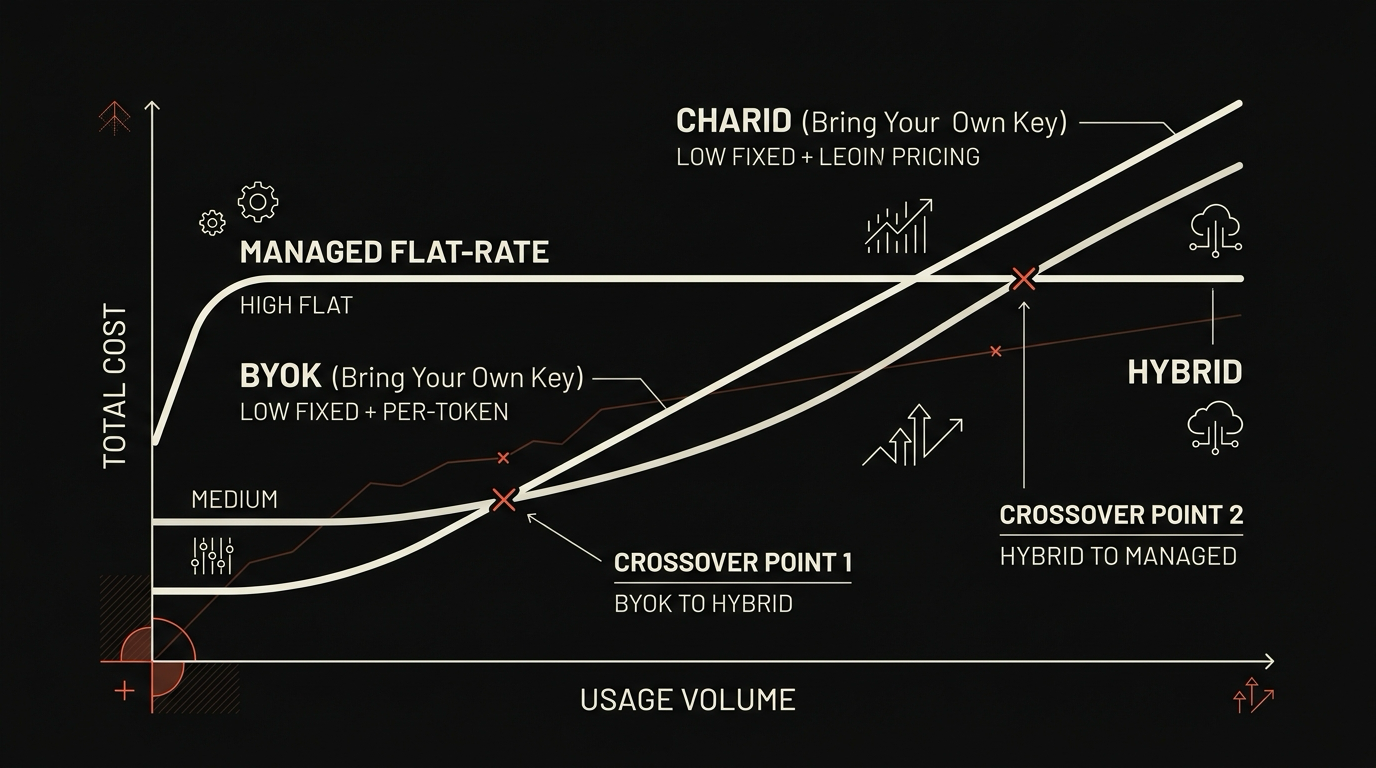
At the hobby tier, managed-AI subscriptions usually cost between $20 and $30. So managed wins on price for a single light user, because the vendor is subsidizing inference to acquire you. The asterisk is that subsidies end when growth slows.
At the pro tier, BYOK is already cheaper than any managed flat rate, and the gap widens fast. A pro user who runs the assistant on twenty pages a day is in this tier within a quarter.
At the team tier, the managed price is not a typo. This is what raw inference costs at list price. Vendors who offer flat-rate enterprise plans either rate-limit aggressively, route to cheaper models, or both. BYOK at this tier is also expensive, but the spend is visible and per-seat tunable.
Local takes a different shape. The marginal cost is your electricity, somewhere between $0.001 and $0.01 per long task on a recent laptop. The fixed cost is your machine and the time to set it up. Local is the cheapest per token by a wide margin and the most expensive per setup hour.
The hybrid path most users will land on
Section titled “The hybrid path most users will land on”After three months of watching real usage, we expect most Maho users to settle on a hybrid. Not because we recommend it, but because that is what the data shows.
The shape is roughly this. A small local model handles cheap, high-volume tasks: page summaries, link rewrites, autocomplete, the things you trigger thirty times a day. A managed frontier model handles the expensive ten percent: long-form reasoning, complex tool calls, anything where quality matters more than latency.
The router lives in the browser. We are building a default router that picks based on task type, not based on a vendor relationship. You can override it. You can disable it. You can point everything at one model if you prefer simplicity.
This shape was not on our roadmap a year ago. It emerged from BYOK telemetry that users opted into, plus a few hundred conversations with people running Maho daily. The pattern is consistent enough that we are now treating hybrid as the default mental model, not the edge case.
The architecture that makes this hybrid possible is documented in our BYOK architecture explained post. The cost shape is reflected in our pricing page, which is intentionally simple and intentionally honest about what we do and do not bundle.
Download Maho
Section titled “Download Maho”Maho is available for macOS, Windows, and Linux and ships with BYOK as the default. You point it at your provider, your key stays in the system keychain, and your prompts route to the model you picked. No silent rerouting, no flat-rate subsidy game, no telemetry on the inference path.
If the hybrid shape above sounds right to you, download Maho.